AccessContextFuzzer - Burp Suite Extension
Exploit / Project Details
A Burp Suite extension (Montoya API) that automatically generates and tests hundreds of access-control-bypass, path-traversal, and Web Cache Deception variants in seconds. Features 40+ header spoofing techniques, a four-phase WCD pipeline with automatic MISS→HIT cache confirmation and no-auth Verify WCD, parallel fuzzing, CDN profiles, sensitive-data detection, and custom rules — lab-proven on official PortSwigger Web Security Academy challenges.
Detailed Write-up
AccessContextFuzzer

AccessContextFuzzer is a Burp Suite extension built on the Montoya API, designed for researchers and pentesters who need to systematically test for access control bypass and Web Cache Deception (WCD) vulnerabilities. Instead of manually crafting dozens of header and path variations, it automatically generates and tests hundreds of bypass variants in seconds — then highlights exactly which ones behave differently from the baseline. Three independent fuzzing engines cover HTTP header manipulation, URL path bypass, and selection-targeted fuzzing, all under a single, unified interface.
What's New in v2.4.0
- Automatic MISS→HIT confirmation — When a variant returns a cacheable
200X-Cache: MISSwithmax-age/s-maxage, the scanner resends the same request a few times inside the cache window. IfX-Cacheflips toHIT, the row is flagged🎯 WCD CONFIRMED (MISS→HIT)— the cache-warming step is now automatic instead of a manual Repeater round-trip. - Rewritten
Verify WCD(right-click) — First warms the cache with your current auth until the entry isHIT, then replays without cookies/auth and compares bodies. A confirmed leak requires a no-authHITwhose body matches the authenticated response — cleanly separating✅ CONFIRMED WCDfrom⚠️ HIT but content differsand❌ not cached without auth. - New 🎯 WCD Findings tab — A dedicated tab collects every WCD result (automatic MISS→HIT confirmations and manual verifications) with URL, auth/no-auth status,
X-Cache, verdict, and timestamp. Double-click a row to open the request/response that proves it. - Turkish-locale cache detection fix — On a Turkish-locale JVM,
"hit".toUpperCase()yields"HİT", so everyX-Cache/Cache-Controlcomparison now usesLocale.ROOT. Previously cacheable responses were wrongly reported asMISS.
Installation

Requirements: Burp Suite (Professional or Community) 2023.1+ and Java 17+
Download the latest access-context-fuzzer-*-jar-with-dependencies.jar from the GitHub Releases page, then in Burp Suite go to Extensions → Add, set the extension type to Java, and select the file. An Access Context tab appears in the toolbar.
Context Menu Integration

Right-click any request in Proxy → HTTP History and choose Access Context: Header Fuzz, Path Fuzz, or Fuzz Selection to load it directly into the correct engine tab and begin fuzzing.
Three Fuzzing Engines

1. Header Bypass

Tests IP spoofing and host manipulation across 40+ header variants including X-Forwarded-For, X-Real-IP, X-Client-IP, True-Client-IP, and CF-Connecting-IP. Also covers host override (X-Forwarded-Host, X-Host, X-Original-Host), WebDAV/method swap, Content-Type override, and HTTP/2 pseudo-header injection (:authority, :path). Custom IPs and Header: Value pairs can be loaded from a wordlist. Targets systems that enforce trusted-IP checks or internal-network access controls.
2. Path/GET Bypass
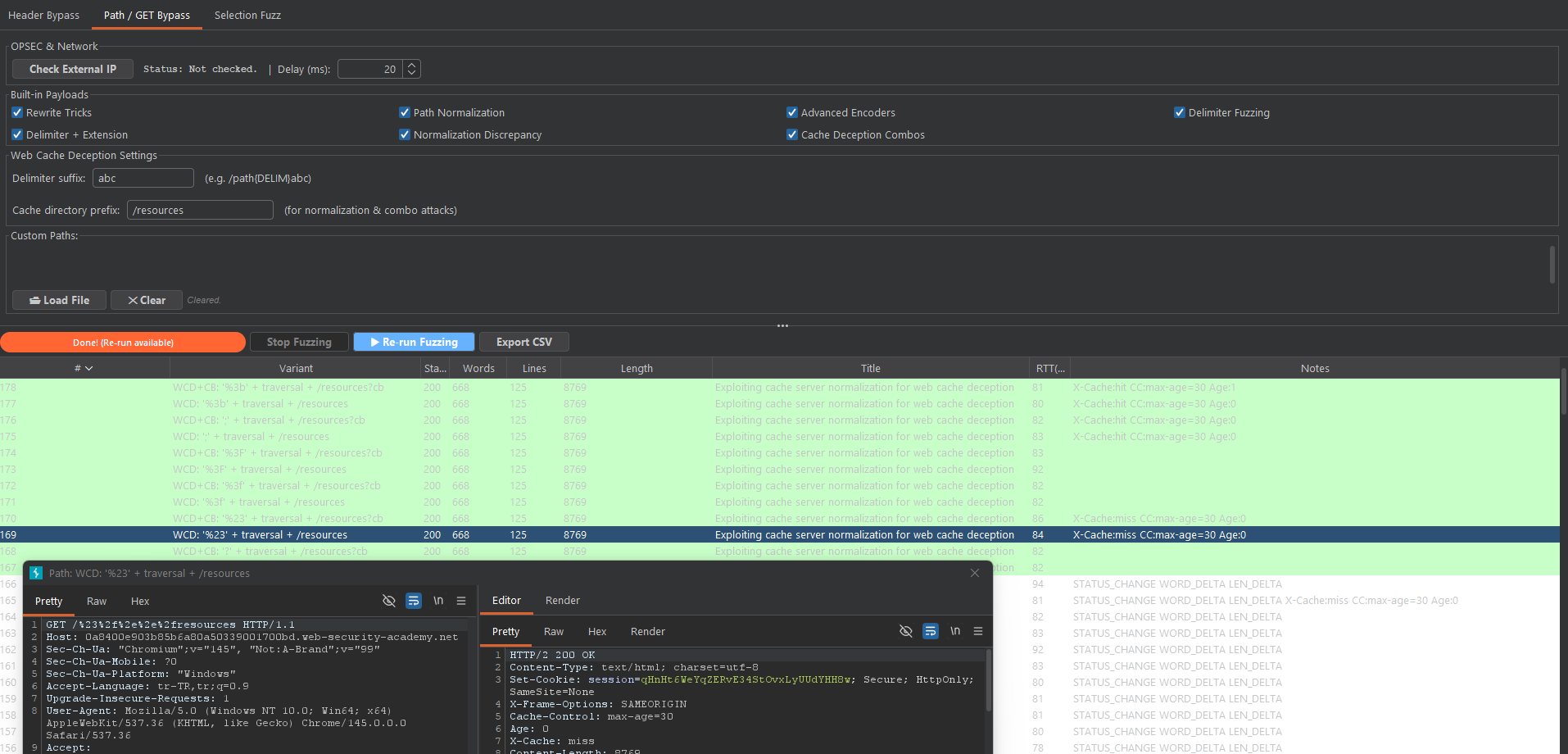
Applies URL encoding, double encoding, IIS Unicode normalization, case flipping, dot-segment injection (/..;/admin), double-slash prefix (//admin), overlong UTF-8, and WCD-specific path techniques. Includes X-Rewrite-URL, X-Original-URL, and Nginx/OpenResty X-Accel-Redirect rewrite tricks. A CDN profile selector (Cloudflare, Akamai, Fastly, CloudFront, Nginx, Varnish) filters delimiter payloads to the target's known delimiter set, and a body-carrying Fat GET option surfaces WCD vectors that path-only testing misses.
3. Selection Fuzz

Focuses fuzzing on a specific text selection within a request, applying URL encode, double URL encode, IIS Unicode, fullwidth-slash, and custom-payload transformations. Supports loading custom wordlists from file for fully customized fuzzing campaigns.
Web Cache Deception Pipeline

Web Cache Deception (WCD) is a class of vulnerability where authenticated pages are cached and served to unauthenticated users, leaking sensitive data. AccessContextFuzzer automates the full attack chain in four phases:
- Delimiter Discovery — Identifies which characters the origin server treats as path delimiters (
?,#,%23,%3f, etc.). - Delimiter + Extension — Combines discovered delimiters with static extensions (19 file types incl.
.js,.css,.png) to trigger caching, including the/path/abc.jspath-mapping vector. - Normalization Discrepancy — Detects path-normalization differences between origin and cache using encoded dot-segments (
..%2f,%252f,%c0%af,%00.css). - Exploit Generation — Synthesizes all findings into a working WCD payload (
/my-account%23%2f%2e%2e%2fresources→200 + X-Cache:hit).

📚 New to WCD? Read Web Cache Deception & Poisoning to understand the theory behind every phase above.
Smart Results Analysis
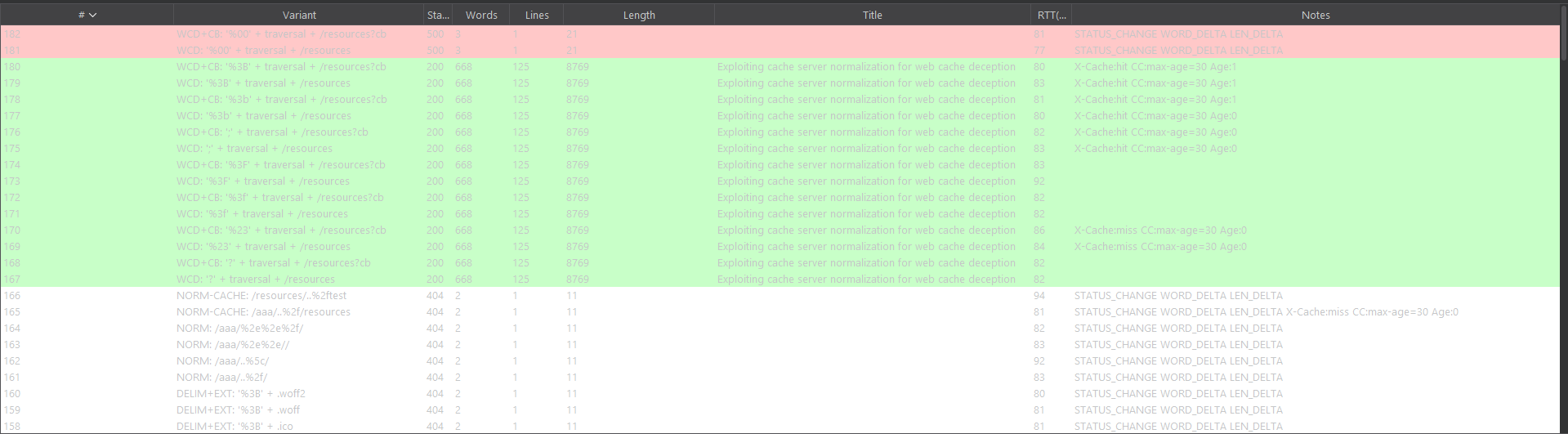
Results are displayed in a color-coded, sortable table with a dedicated Cache column showing HIT ✅, MISS, PRIVATE 🚫, NO-STORE 🚫, or HIT/Vary:Cookie. Automatic anomaly detection is flagged in the Notes column:
🎯 POTENTIAL BYPASS— 40x baseline changed to 2xx (strong bypass signal)🔀 REDIRECT BYPASS?— 401/403 baseline changed to a 30x redirect⚠️ BODY_BYPASS?— Same 2xx status but the body content changedBODY_DIFF— Content difference detected via MD5 hash comparisonSENSITIVE_DATA:JWT— JWT/CSRF/Bearer/API-key/email detected in the body (highlighted pink)CUSTOM:LABEL— A user-definedregex=LABELrule from the Settings tab matched
Additional reliability features: automatic baseline re-verification every 50 requests (session-drift detection), real-time duration estimate via RTT averaging, and adaptive rate-limit protection on 429/503 responses. The 🔍 Show Only Interesting filter hides baseline noise so a single click reveals the bypass.
Parallel Fuzzing & Productivity
Toggle Parallel Mode in the ⚙ Settings & History tab to send requests concurrently with a configurable thread count (2–20). Also included: one-click scan profiles (⚡ Quick Scan, 🔥 Full Scan, 🎯 WCD Only), a 👁 Preview Payloads button that lists every variant before running, a side-by-side Response Diff Viewer against the baseline, and a Scan History log of every completed run.
Request/Response Viewer

Double-click any row to open Burp's native HTTP editors (Montoya HttpRequestEditor / HttpResponseEditor) in a non-modal split pane. Raw, Pretty, Hex, and Render tabs provide complete inspection — the Render tab shows a live HTML preview so you can spot API keys or tokens without reading raw HTML.
OPSEC Verification

A built-in OPSEC module confirms your external IP before testing begins; if the IP is unverified, the extension blocks fuzzing to prevent accidental exposure of your real IP. A single, persisted Delay (ms) shared by all engines lives in the Settings tab.
Export & Integration
Multi-select rows (Ctrl/Shift+Click) and use Send All Selected or Send All Interesting to push them to Repeater, save results with Export CSV, and note that all fuzzing requests are natively added to Burp's Site Map.
Building from Source
git clone https://github.com/Tagoletta/AccessContextFuzzer.git
cd AccessContextFuzzer
mvn compile
mvn package
# Output: target/access-context-fuzzer-2.4.0-jar-with-dependencies.jar
Requires JDK 17+ and Maven 3.6+. The source is organized into a modular burp.core, burp.util, burp.payload, and burp.ui package structure.
Lab-Proven Effectiveness

AccessContextFuzzer successfully solves official PortSwigger Web Security Academy labs:
- URL-based access control can be circumvented — root-level URL rewrite via
X-Original-URL - Host header authentication bypass — host manipulation via
X-Forwarded-Host - Authentication bypass via information disclosure — custom
X-Custom-IP-Authorization: 127.0.0.1header - Exploiting cache server normalization for WCD — delimiter + encoded dot-segment + cache prefix (
Cache Deception Combos)
AccessContextFuzzer
AccessContextFuzzer is a Burp Suite extension built on the Montoya API, designed for researchers and pentesters who need to systematically test for access control bypass and Web Cache Deception (WCD) vulnerabilities. Instead of manually crafting dozens of header and path variations, it automatically generates and tests hundreds of bypass variants in seconds — then highlights exactly which ones behave differently from the baseline. Three independent fuzzing engines cover HTTP header manipulation, URL path bypass, and selection-targeted fuzzing, all under a single, unified interface.
What's New in v2.4.0
- Automatic MISS→HIT confirmation — When a variant returns a cacheable
200X-Cache: MISSwithmax-age/s-maxage, the scanner resends the same request a few times inside the cache window. IfX-Cacheflips toHIT, the row is flagged🎯 WCD CONFIRMED (MISS→HIT)— the cache-warming step is now automatic instead of a manual Repeater round-trip. - Rewritten
Verify WCD(right-click) — First warms the cache with your current auth until the entry isHIT, then replays without cookies/auth and compares bodies. A confirmed leak requires a no-authHITwhose body matches the authenticated response — cleanly separating✅ CONFIRMED WCDfrom⚠️ HIT but content differsand❌ not cached without auth. - New 🎯 WCD Findings tab — A dedicated tab collects every WCD result (automatic MISS→HIT confirmations and manual verifications) with URL, auth/no-auth status,
X-Cache, verdict, and timestamp. Double-click a row to open the request/response that proves it. - Turkish-locale cache detection fix — On a Turkish-locale JVM,
"hit".toUpperCase()yields"HİT", so everyX-Cache/Cache-Controlcomparison now usesLocale.ROOT. Previously cacheable responses were wrongly reported asMISS.
Installation
Requirements: Burp Suite (Professional or Community) 2023.1+ and Java 17+
Download the latest access-context-fuzzer-*-jar-with-dependencies.jar from the GitHub Releases page, then in Burp Suite go to Extensions → Add, set the extension type to Java, and select the file. An Access Context tab appears in the toolbar.
Context Menu Integration
Right-click any request in Proxy → HTTP History and choose Access Context: Header Fuzz, Path Fuzz, or Fuzz Selection to load it directly into the correct engine tab and begin fuzzing.
Three Fuzzing Engines
1. Header Bypass
Tests IP spoofing and host manipulation across 40+ header variants including X-Forwarded-For, X-Real-IP, X-Client-IP, True-Client-IP, and CF-Connecting-IP. Also covers host override (X-Forwarded-Host, X-Host, X-Original-Host), WebDAV/method swap, Content-Type override, and HTTP/2 pseudo-header injection (:authority, :path). Custom IPs and Header: Value pairs can be loaded from a wordlist. Targets systems that enforce trusted-IP checks or internal-network access controls.
2. Path/GET Bypass
Applies URL encoding, double encoding, IIS Unicode normalization, case flipping, dot-segment injection (/..;/admin), double-slash prefix (//admin), overlong UTF-8, and WCD-specific path techniques. Includes X-Rewrite-URL, X-Original-URL, and Nginx/OpenResty X-Accel-Redirect rewrite tricks. A CDN profile selector (Cloudflare, Akamai, Fastly, CloudFront, Nginx, Varnish) filters delimiter payloads to the target's known delimiter set, and a body-carrying Fat GET option surfaces WCD vectors that path-only testing misses.
3. Selection Fuzz
Focuses fuzzing on a specific text selection within a request, applying URL encode, double URL encode, IIS Unicode, fullwidth-slash, and custom-payload transformations. Supports loading custom wordlists from file for fully customized fuzzing campaigns.
Web Cache Deception Pipeline
Web Cache Deception (WCD) is a class of vulnerability where authenticated pages are cached and served to unauthenticated users, leaking sensitive data. AccessContextFuzzer automates the full attack chain in four phases:
- Delimiter Discovery — Identifies which characters the origin server treats as path delimiters (
?,#,%23,%3f, etc.). - Delimiter + Extension — Combines discovered delimiters with static extensions (19 file types incl.
.js,.css,.png) to trigger caching, including the/path/abc.jspath-mapping vector. - Normalization Discrepancy — Detects path-normalization differences between origin and cache using encoded dot-segments (
..%2f,%252f,%c0%af,%00.css). - Exploit Generation — Synthesizes all findings into a working WCD payload (
/my-account%23%2f%2e%2e%2fresources→200 + X-Cache:hit).
📚 New to WCD? Read Web Cache Deception & Poisoning to understand the theory behind every phase above.
Smart Results Analysis
Results are displayed in a color-coded, sortable table with a dedicated Cache column showing HIT ✅, MISS, PRIVATE 🚫, NO-STORE 🚫, or HIT/Vary:Cookie. Automatic anomaly detection is flagged in the Notes column:
🎯 POTENTIAL BYPASS— 40x baseline changed to 2xx (strong bypass signal)🔀 REDIRECT BYPASS?— 401/403 baseline changed to a 30x redirect⚠️ BODY_BYPASS?— Same 2xx status but the body content changedBODY_DIFF— Content difference detected via MD5 hash comparisonSENSITIVE_DATA:JWT— JWT/CSRF/Bearer/API-key/email detected in the body (highlighted pink)CUSTOM:LABEL— A user-definedregex=LABELrule from the Settings tab matched
Additional reliability features: automatic baseline re-verification every 50 requests (session-drift detection), real-time duration estimate via RTT averaging, and adaptive rate-limit protection on 429/503 responses. The 🔍 Show Only Interesting filter hides baseline noise so a single click reveals the bypass.
Parallel Fuzzing & Productivity
Toggle Parallel Mode in the ⚙ Settings & History tab to send requests concurrently with a configurable thread count (2–20). Also included: one-click scan profiles (⚡ Quick Scan, 🔥 Full Scan, 🎯 WCD Only), a 👁 Preview Payloads button that lists every variant before running, a side-by-side Response Diff Viewer against the baseline, and a Scan History log of every completed run.
Request/Response Viewer
Double-click any row to open Burp's native HTTP editors (Montoya HttpRequestEditor / HttpResponseEditor) in a non-modal split pane. Raw, Pretty, Hex, and Render tabs provide complete inspection — the Render tab shows a live HTML preview so you can spot API keys or tokens without reading raw HTML.
OPSEC Verification
A built-in OPSEC module confirms your external IP before testing begins; if the IP is unverified, the extension blocks fuzzing to prevent accidental exposure of your real IP. A single, persisted Delay (ms) shared by all engines lives in the Settings tab.
Export & Integration
Multi-select rows (Ctrl/Shift+Click) and use Send All Selected or Send All Interesting to push them to Repeater, save results with Export CSV, and note that all fuzzing requests are natively added to Burp's Site Map.
Building from Source
git clone https://github.com/Tagoletta/AccessContextFuzzer.git
cd AccessContextFuzzer
mvn compile
mvn package
# Output: target/access-context-fuzzer-2.4.0-jar-with-dependencies.jar
Requires JDK 17+ and Maven 3.6+. The source is organized into a modular burp.core, burp.util, burp.payload, and burp.ui package structure.
Lab-Proven Effectiveness
AccessContextFuzzer successfully solves official PortSwigger Web Security Academy labs:
- URL-based access control can be circumvented — root-level URL rewrite via
X-Original-URL - Host header authentication bypass — host manipulation via
X-Forwarded-Host - Authentication bypass via information disclosure — custom
X-Custom-IP-Authorization: 127.0.0.1header - Exploiting cache server normalization for WCD — delimiter + encoded dot-segment + cache prefix (
Cache Deception Combos)
AccessContextFuzzer — Proje Detayları
AccessContextFuzzer, Burp Suite'in Montoya API'si üzerine inşa edilmiş, erişim kontrolü testlerini manuel ve yorucu yapılandırmalardan kurtaran bir güvenlik otomasyon aracıdır. Onlarca header ve path varyasyonunu elle hazırlamak yerine, eklenti yüzlerce bypass varyantını saniyeler içinde otomatik olarak üretip test eder ve baseline'dan farklı davrananları anında vurgular. Header manipülasyonundan Web Cache Deception saldırılarına kadar geniş bir test yelpazesini tek, birleşik bir arayüz altında sunar.
v2.4.0 — Öne Çıkanlar
- Otomatik MISS→HIT doğrulaması — Önbelleğe alınabilir bir
200X-Cache: MISSyanıtı görüldüğünde tarayıcı aynı isteği cache penceresi içinde birkaç kez yeniden gönderir.X-CacheHIT'e dönerse satır🎯 WCD CONFIRMED (MISS→HIT)olarak işaretlenir — önbellek ısıtma adımı artık manuel Repeater turu gerektirmez. - Yeniden yazılmış
Verify WCD(sağ tık) — Önce mevcut kimlik bilgilerinizle önbelleği ısıtır (HITolana kadar), sonra çerez/kimlik doğrulama olmadan yeniden oynatıp gövdeleri karşılaştırır. Kimlik doğrulamasız birHIT, yetkili yanıtla eşleşen bir gövde döndürüyorsa✅ CONFIRMED WCDolarak onaylanır. - Yeni 🎯 WCD Findings sekmesi — Tüm WCD sonuçlarını (otomatik onaylar + manuel doğrulamalar) URL, auth/no-auth durumu,
X-Cache, karar ve zaman damgasıyla toplar. Kanıt istek/yanıtını açmak için satıra çift tıklayın. - Türkçe-locale önbellek tespiti düzeltmesi — Türkçe JVM'de
"hit".toUpperCase()→"HİT"olduğundan tümX-Cache/Cache-Controlkarşılaştırmaları artıkLocale.ROOTkullanır. (Önceden önbelleğe alınabilir yanıtlar hatalı biçimdeMISSraporlanıyordu.)
Kurulum
Gereksinimler: Burp Suite (Professional veya Community) 2023.1+ ve Java 17+
GitHub Releases sayfasından en son access-context-fuzzer-*-jar-with-dependencies.jar dosyasını indirin, ardından Burp Suite'te Extensions → Add menüsünden, tür olarak Java seçip dosyayı yükleyin. Araç çubuğunda Access Context sekmesi belirir.
Bağlam Menüsü Entegrasyonu
Proxy → HTTP History üzerindeki herhangi bir isteğe sağ tıklayarak Access Context: Header Fuzz, Path Fuzz veya Fuzz Selection seçeneğiyle testi anında başlatabilirsiniz. İstek otomatik olarak ilgili motor sekmesine yüklenir.
Üç Fuzzing Motoru
1. Header Bypass
X-Forwarded-For, X-Real-IP, X-Client-IP, True-Client-IP, CF-Connecting-IP dahil 40'tan fazla başlık varyantıyla IP spoofing ve host manipülasyonunu test eder. Ayrıca host override (X-Forwarded-Host, X-Host, X-Original-Host), WebDAV/method swap, Content-Type override ve HTTP/2 pseudo-header (:authority, :path) enjeksiyonu içerir. Özel IP ve Header: Value çiftleri wordlist'ten yüklenebilir. Güvenilir IP veya iç ağ kontrolü uygulayan sistemlere yöneliktir.
2. Path/GET Bypass
URL kodlaması, çift kodlama, IIS Unicode normalizasyonu, büyük/küçük harf manipülasyonu, nokta-segment enjeksiyonu (/..;/admin), çift eğik çizgi (//admin), overlong UTF-8 ve WCD'ye özgü yol tekniklerini test eder. X-Rewrite-URL, X-Original-URL ve Nginx/OpenResty X-Accel-Redirect rewrite hilelerini içerir. Ek olarak, hedefin CDN'ini (Cloudflare, Akamai, Fastly, CloudFront, Nginx, Varnish) seçerek delimiter payload'larını filtreleyebilir ve gövde taşıyan Fat GET ile yalnızca-path testinin kaçırdığı WCD vektörlerini yakalayabilirsiniz.
3. Selection Fuzz
İstek içindeki belirli bir metin seçimine odaklanarak URL encode, çift URL encode, IIS Unicode, fullwidth eğik çizgi ve özel payload dönüşümleri uygular. Dosyadan özel wordlist yükleme desteğiyle tamamen özelleştirilmiş fuzzing kampanyaları oluşturulabilir.
Web Cache Deception Pipeline
Web Cache Deception (WCD), kimlik doğrulama gerektiren sayfaların cache'e alınmasına neden olarak hassas verilerin yetkisiz kullanıcılara sunulduğu kritik bir güvenlik açığı sınıfıdır. AccessContextFuzzer bu saldırı zincirini dört aşamada otomatikleştirir:
- Sınırlayıcı Keşfi — Origin sunucunun hangi yol sınırlayıcılarını (
?,#,%23,%3fvb.) tanıdığını belirler. - Uzantı Testi — Keşfedilen sınırlayıcılarla birlikte
.js,.css,.pnggibi statik uzantılar (toplam 19 tip) denenerekX-Cachedavranışı tetiklenir./path/abc.jsyol-eşleme vektörü de dahildir. - Normalizasyon Tutarsızlığı — Origin sunucu ile cache katmanı arasındaki kodlanmış nokta-segment (
..%2f,%252f,%c0%af,%00.css) normalizasyon farklılıklarını tespit eder. - İstismar Üretimi — Tüm bulgular birleştirilerek çalışan bir WCD payload'ı sentezlenir (
/my-account%23%2f%2e%2e%2fresources→200 + X-Cache:hit).
📚 WCD teorisi: Her aşamanın arkasındaki mantığı anlamak için Web Cache Deception & Poisoning yazısını okuyabilirsiniz.
Akıllı Sonuç Analizi
Sonuçlar renk kodlu, sıralanabilir bir tabloda sunulur; ayrı bir Cache sütunu HIT ✅, MISS, PRIVATE 🚫, NO-STORE 🚫, HIT/Vary:Cookie durumlarını gösterir. Otomatik anomali tespiti Notes sütununda işaretlenir:
🎯 POTENTIAL BYPASS— 40x baseline'dan 2xx'e geçiş (güçlü bypass sinyali)🔀 REDIRECT BYPASS?— 401/403 baseline'ın 30x redirect'e dönmesi⚠️ BODY_BYPASS?— Aynı 2xx durumu, farklı gövdeBODY_DIFF— MD5 hash karşılaştırmasıyla tespit edilen içerik farkıSENSITIVE_DATA:JWT— Yanıt gövdesinde JWT/CSRF/Bearer/API key/e-posta tespiti (pembe satır olarak vurgulanır)CUSTOM:LABEL— Settings sekmesinde tanımlananregex=LABELözel kuralı eşleşmesi
Ek güvenilirlik özellikleri: her 50 istekte otomatik baseline yenilemesi (oturum kayması tespiti), RTT ortalamasıyla gerçek zamanlı süre tahmini, ve 429/503 yanıtlarında uyarlamalı rate-limit koruması. 🔍 Show Only Interesting filtresiyle baseline gürültüsü gizlenir.
Paralel Fuzzing & Verimlilik
⚙ Settings & History sekmesinden Parallel Mode açılarak istekler eşzamanlı gönderilir (yapılandırılabilir 2–20 iş parçacığı). Ayrıca 1-tık tarama profilleri (⚡ Quick Scan, 🔥 Full Scan, 🎯 WCD Only), taramadan önce tüm varyantları listeleyen 👁 Preview Payloads, baseline'a karşı yan yana Response Diff Viewer ve her taramayı kaydeden Scan History bulunur.
İstek/Yanıt Görüntüleyici
Herhangi bir satıra çift tıklandığında Burp'ün yerel HTTP editörleri (Montoya HttpRequestEditor/HttpResponseEditor) modal olmayan bir bölünmüş panelde açılır. Raw, Pretty, Hex ve Render sekmeleriyle tam istek/yanıt analizi yapılabilir — Render sekmesi, ham HTML okumadan API key veya token'ları anında görmenizi sağlar.
OPSEC Doğrulama
Test başlamadan önce genel IP adresinizi doğrulayan yerleşik OPSEC modülü, IP doğrulanmadıysa fuzzing'i bloklar ve gerçek IP'nizin hedefe sızmasını önler. Tüm motorların paylaştığı, yeniden başlatmalar arasında kalıcı tek bir Delay (ms) ayarı Settings sekmesinde toplanmıştır.
Dışa Aktarma & Entegrasyon
Çoklu seçimle (Ctrl/Shift+Click) Send All Selected veya Send All Interesting ile satırları Repeater'a gönderin, sonuçları Export CSV ile kaydedin. Tüm fuzzing istekleri Burp'ün Site Map'ine doğal olarak eklenir.
Kaynaktan Derleme
git clone https://github.com/Tagoletta/AccessContextFuzzer.git
cd AccessContextFuzzer
mvn compile
mvn package
# Çıktı: target/access-context-fuzzer-2.4.0-jar-with-dependencies.jar
Gereksinimler: JDK 17+ ve Maven 3.6+. Kaynak, burp.core, burp.util, burp.payload ve burp.ui paketlerine ayrılmış modüler bir yapıya sahiptir.
Lab Kanıtlı Etkinlik
AccessContextFuzzer, resmi PortSwigger Web Security Academy laboratuvarlarını başarıyla çözmektedir:
- URL-based access control can be circumvented —
X-Original-URLile kök seviye URL rewrite - Host header authentication bypass —
X-Forwarded-Hostile host manipülasyonu - Authentication bypass via information disclosure —
X-Custom-IP-Authorization: 127.0.0.1özel başlığı - Exploiting cache server normalization for WCD — sınırlayıcı + kodlanmış nokta-segment + cache prefix (
Cache Deception Combos)